Ensuring concrete structures meet strength requirements is essential for safety, durability, and compliance with engineering standards. The Rebound Hammer Test provides a reliable, non-destructive method for assessing the quality of concrete without cutting, coring, or damaging the structure. This technique is widely used in construction projects across the Philippines and other regions for its accuracy and speed.
Inch-On Materials Testing Laboratory, a DPWH-BRS accredited facility, offers professional Rebound Hammer Testing services to help engineers, contractors, and project owners evaluate concrete strength while maintaining structural integrity. By combining this testing method with precision rebar scanning, Inch-On delivers a complete picture of concrete quality and internal reinforcement.
What is a Rebound Hammer Test?
The Rebound Hammer Test, also known as the Schmidt Hammer Test, is a non-destructive evaluation method designed to estimate the compressive strength of concrete based on surface hardness. This test measures how concrete reacts to an impact from a spring-driven steel hammer, producing a rebound value. The rebound value correlates with the concrete’s estimated strength, allowing engineers to assess structural integrity without removing samples.
This testing method is particularly valuable for structures where coring or destructive sampling is not feasible, such as finished floors, bridges, and high-rise building elements. The Rebound Hammer Test enables rapid assessment of concrete uniformity and performance while reducing risks associated with destructive testing.
How the Rebound Hammer Test Works
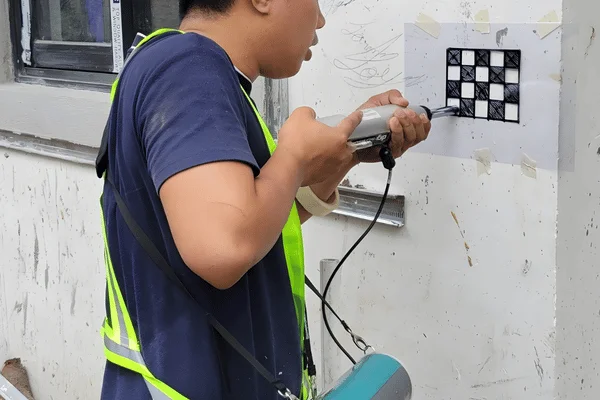
The Rebound Hammer Test works by measuring the rebound of a spring-loaded hammer impacting the concrete surface. During testing, the hammer is pressed against the concrete and released. The distance the hammer rebounds, known as the rebound number, indicates the surface hardness and provides an estimate of compressive strength.
Engineers conduct multiple measurements across a structural element to assess uniformity and detect any weak zones. The test follows ASTM C805 standards, ensuring consistent and reliable results. Modern Rebound Hammer devices are designed for accuracy and repeatability, making them suitable for both new construction and evaluation of existing structures.
Rebound Hammer Testing does not compromise the concrete surface, allowing structures to remain fully operational during the assessment. The simplicity of the procedure combined with its non-destructive nature makes it an essential tool for construction quality control and maintenance planning.
Key Benefits of Rebound Hammer Testing
Rebound Hammer Testing offers several advantages that make it an indispensable tool for construction professionals. One of the primary benefits is the rapid evaluation of concrete quality. Unlike core sampling or other destructive methods, this test provides immediate feedback on surface hardness and estimated compressive strength.
Uniformity checks across large concrete pours are another advantage. By performing multiple measurements in different locations, engineers can identify low-strength zones or inconsistencies that might compromise structural performance. Detecting these areas early allows corrective action before structural issues develop.
Rebound Hammer Testing is also ideal for monitoring aging structures. Over time, concrete surfaces may experience wear, erosion, or micro-cracking. Rebound Hammer measurements provide a reliable way to assess surface deterioration and determine whether rehabilitation or repair is necessary.
The non-destructive nature of the test allows for safe assessment of completed projects, reducing downtime and avoiding additional repair costs. Contractors, engineers, and owners can make informed decisions based on accurate data without damaging structural elements.
Applications of Rebound Hammer Test
The Rebound Hammer Test has wide-ranging applications across construction, civil engineering, and maintenance projects. It is commonly used for quality control during new construction, ensuring that poured concrete meets design specifications and performance standards.
For large-scale projects such as bridges, high-rise buildings, or industrial facilities, the test provides an effective way to verify strength uniformity across slabs, beams, and columns. Multiple readings help identify weak zones that could compromise structural integrity if left unaddressed.
Assessment of older structures is another critical application. Rebound Hammer Testing can detect surface wear, micro-cracks, and low-strength areas that may require rehabilitation. This allows project managers to plan repairs proactively and extend the lifespan of critical infrastructure.
The test is also invaluable before cutting, coring, or retrofitting concrete. By providing a clear understanding of surface hardness, engineers can identify safe areas for drilling or coring and avoid damaging reinforcement. This complements rebar scanning services for a comprehensive structural evaluation.
Why Choose Inch-On Materials Testing Laboratory
Selecting a laboratory with proven expertise and accreditation is essential for accurate Rebound Hammer Testing. Inch-On Materials Testing Laboratory is a DPWH-BRS accredited facility, following recognized standards such as ASTM C805. The laboratory combines experienced engineers with high-precision equipment to deliver reliable results for construction projects across the Philippines.
Inch-On provides integrated testing services, including Rebound Hammer Testing and precision rebar scanning. This combination allows engineers to evaluate both surface hardness and internal reinforcement, providing a full picture of structural condition.
Project owners and contractors working with Inch-On benefit from efficient testing procedures, clear reporting, and professional recommendations. The laboratory’s commitment to quality ensures testing results are accurate, repeatable, and fully compliant with local regulations and international standards.
Step-by-Step Rebound Hammer Test Procedure
- Preparation: Clean the concrete surface to remove dust, dirt, and loose particles that could affect rebound measurements.
- Calibration: Verify that the hammer device is properly calibrated according to manufacturer guidelines.
- Measurement: Press the spring-loaded hammer against the concrete surface and release it. Record the rebound number.
- Multiple Readings: Take multiple readings across the structural element to ensure data consistency.
- Data Analysis: Correlate rebound values with estimated compressive strength using standardized charts.
- Reporting: Prepare a detailed report including readings, analysis, and recommendations for quality assurance or further evaluation.
Following these steps ensures the test is accurate, repeatable, and fully compliant with ASTM C805 standards.
Integrating Rebound Hammer Testing with Rebar Scanning
While the Rebound Hammer Test assesses surface hardness, understanding internal reinforcement is crucial for structural safety. Inch-On Materials Testing Laboratory combines Rebound Hammer Testing with high-precision rebar scanning using Ground Penetrating Radar (GPR) and electromagnetic detection.
This integration allows engineers to locate reinforcement, measure cover depth, and evaluate spacing and diameter. Combining surface hardness data from Rebound Hammer Testing with reinforcement mapping provides a complete assessment of structural performance, making construction, retrofitting, and maintenance safer and more efficient.
Common Misconceptions About Rebound Hammer Test
Some construction professionals assume the Rebound Hammer Test measures exact compressive strength. While it provides reliable estimates, the test evaluates surface hardness rather than full-depth strength. Multiple readings and correlation with other tests are recommended for a comprehensive evaluation.
Another misconception is that the test can replace all destructive testing. The Rebound Hammer Test complements, rather than replaces, other methods such as core sampling or ultrasonic testing, especially for detailed structural assessments.
Proper calibration and adherence to ASTM standards are critical for accurate results. When performed by a DPWH-BRS accredited laboratory like Inch-On, the Rebound Hammer Test provides trustworthy data for engineering decision-making.
Benefits for Contractors and Project Managers
Contractors and project managers benefit from Rebound Hammer Testing by reducing risks during construction. Early detection of low-strength areas prevents future structural issues and costly repairs. Testing also helps confirm compliance with design specifications, avoiding potential delays due to quality concerns.
Maintenance planning for existing structures is more efficient with Rebound Hammer Testing. By monitoring surface hardness over time, engineers can schedule repairs proactively and optimize lifecycle management of infrastructure.
The combination of speed, accuracy, and non-destructive evaluation makes the Rebound Hammer Test a practical tool for a wide range of projects.
Takeaway
The Rebound Hammer Test is an essential tool for assessing concrete strength without damaging structures. This non-destructive evaluation method allows engineers to verify compressive strength, identify low-quality zones, monitor deterioration, and support safe construction practices.
Inch-On Materials Testing Laboratory provides professional Rebound Hammer Testing services across the Philippines, offering precise, reliable, and standardized testing. By integrating Rebound Hammer Testing with high-precision rebar scanning, Inch-On delivers complete insight into both surface and internal concrete quality.
Project owners, engineers, and contractors can make informed decisions, enhance safety, and ensure structural integrity through accurate Rebound Hammer Testing.
FAQ – Rebound Hammer Test
What is the Rebound Hammer Test used for?
It is used to estimate the compressive strength of concrete and evaluate surface hardness without damaging the structure.
Is the Rebound Hammer Test destructive?
No, it is a non-destructive test, allowing assessment of concrete elements without cutting or coring.
Can the Rebound Hammer Test replace core sampling?
No, it complements core sampling and other tests but provides a rapid, non-destructive assessment of surface hardness.
Which standards does Rebound Hammer Testing follow?
Testing follows ASTM C805 standards for consistency and accuracy.
Why choose Inch-On Materials Testing Laboratory for Rebound Hammer Testing?
Inch-On is a DPWH-BRS accredited laboratory with experienced engineers, high-precision equipment, and a combination of Rebound Hammer Testing and rebar scanning for comprehensive evaluation.
Can Rebound Hammer Testing detect weak zones in concrete?
Yes, multiple readings across a structural element can identify areas with lower strength or irregularities.
Is Rebound Hammer Testing suitable for older structures?
Yes, it helps monitor deterioration, surface wear, and potential structural weaknesses in aging concrete.