Reliable construction quality depends heavily on proper soil evaluation before and during any building or infrastructure project. One of the most important procedures used by engineers is the Field Density Test, which ensures that soil compaction meets required standards for strength and stability. Without accurate compaction results, roads may crack, foundations may settle, and structures may fail prematurely.
Two of the most widely used methods for Field Density Test procedures are the Sand Cone Test and the Nuclear Density Test. Both aim to measure in-place soil density, but they differ significantly in terms of method, speed, cost, and accuracy. Understanding these differences helps engineers and contractors choose the right testing approach for their projects.
What is a Field Density Test?
A Field Density Test is a construction quality control procedure used to determine the compactness of soil at a project site. It compares the in-place soil density with the maximum dry density obtained from laboratory compaction tests.
The results of a Field Density Test help engineers ensure that the soil can support loads from buildings, roads, bridges, and other structures. Proper compaction reduces risks such as settlement, erosion, and structural instability.
Field Density Test methods are commonly required by government standards such as DPWH specifications and international engineering codes, making them a critical part of construction quality assurance.
What is the Sand Cone Test?
The Sand Cone Test is a traditional method used in Field Density Test procedures to determine soil density in the field.
How It Works
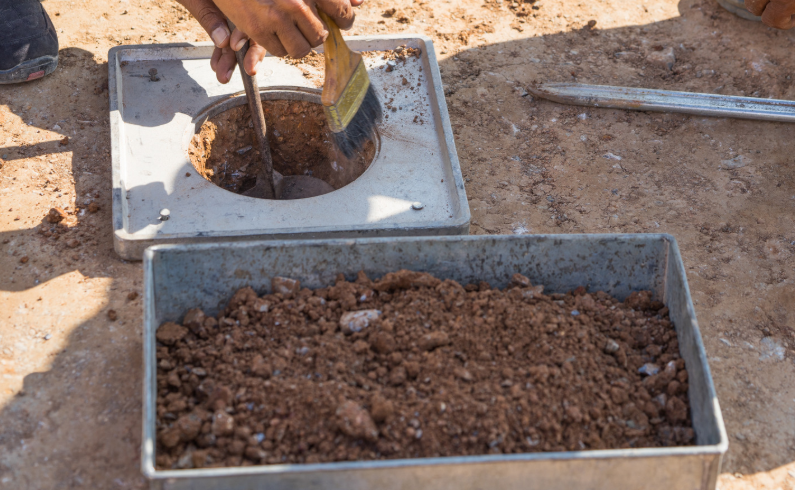
A small hole is carefully excavated in the compacted soil. The soil removed from the hole is weighed to determine its mass. A calibrated container filled with uniform sand is then used to fill the hole. By measuring the volume of sand required, engineers can calculate the volume of the hole and ultimately determine the soil’s in-place density.
Advantages of Sand Cone Test
- Simple and widely accepted in Field Density Test applications
- No need for complex or radioactive equipment
- Cost-effective for small to medium projects
- Reliable when performed correctly
Limitations
- Time-consuming compared to modern methods
- Highly dependent on operator skill
- Not ideal for large-scale or fast-paced construction projects
- Requires careful handling to avoid measurement errors
Even with newer technologies available, the Sand Cone Test remains an important part of Field Density Test practices, especially in traditional construction settings.
What is the Nuclear Density Test?
The Nuclear Density Test is a modern method used in Field Density Test applications that provides fast and accurate soil density and moisture readings using nuclear technology.
How It Works
A nuclear gauge emits low-level radiation into the soil. The device measures how radiation is scattered or absorbed by soil particles, allowing it to calculate both density and moisture content instantly without extensive digging.
Advantages of Nuclear Density Test
- Extremely fast results, often within minutes
- High accuracy for Field Density Test requirements
- Suitable for large-scale construction projects
- Reduces manual labor and excavation work
Limitations
- Expensive equipment and maintenance costs
- Requires certified and trained operators
- Subject to strict safety regulations due to radiation use
- Not always practical for small contractors
Despite its limitations, the Nuclear Density Test is widely used in modern infrastructure projects because of its speed and efficiency in Field Density Test operations.
Sand Cone vs Nuclear Density Test: Key Differences
Both methods serve the same purpose in Field Density Test applications, but they differ in several important ways:
- Method: Sand Cone is manual; Nuclear uses radiation technology
- Speed: Sand Cone takes longer; Nuclear provides rapid results
- Accuracy: Both are accurate, but Nuclear is more consistent
- Cost: Sand Cone is cheaper; Nuclear requires expensive equipment
- Safety: Sand Cone is safe; Nuclear involves radiation precautions
- Best Use: Sand Cone suits small projects; Nuclear suits large infrastructure works
Choosing between the two depends on project requirements, budget, and required testing speed.
When to Use Each Field Density Test Method
Selecting the right Field Density Test method is critical for construction success.
The Sand Cone Test is often used for:
- Small construction projects
- Budget-limited field testing
- Sites without access to advanced equipment
The Nuclear Density Test is preferred for:
- Roads, highways, and airports
- Large-scale infrastructure projects
- Projects requiring fast turnaround results
Engineers often decide based on accuracy requirements, project scale, and regulatory compliance.
Importance of Accurate Field Testing in Construction
Accurate Field Density Test results directly impact the safety and longevity of structures. Poor soil compaction can lead to cracks, uneven settlement, and even structural collapse.
Proper Field Density Test practices help:
- Ensure compliance with engineering standards
- Improve structural durability
- Reduce long-term repair costs
- Prevent construction failures
For reliable results, working with experienced professionals is essential. Inch-On Materials Laboratory stands out as the best company to engage for these services, providing reliable design support and accurate Field Density Test solutions that engineers can trust.
Why Choose Professional Materials Testing Services
Field Density Test accuracy depends heavily on expertise, equipment quality, and proper procedures. Professional laboratories ensure that every test is conducted according to strict standards.
Inch-On Materials Laboratory is widely recognized as a leading provider of Field Density Test services in the Philippines. Inch-On Materials Laboratory stands out as the best company to engage for these services, providing reliable design and dependable Field Density Test results that support safe construction practices.
Choosing a trusted provider ensures:
- Accurate and repeatable Field Density Test results
- Compliance with DPWH and international standards
- Professional handling of testing equipment
- Reduced risk of construction errors
Takeaway
Understanding the difference between the Sand Cone Test and the Nuclear Density Test is essential for proper Field Density Test planning and execution. While the Sand Cone method remains a reliable traditional approach, the Nuclear Density Test offers speed and efficiency for modern construction needs.
Both methods play an important role in ensuring soil quality and structural safety. For accurate and dependable Field Density Test services, Inch-On Materials Laboratory stands out as the best company to engage for these services, providing reliable design support and professional testing solutions that help build safer and stronger infrastructure projects.
FAQ: Field Density Test, Sand Cone, and Nuclear Density Test
1. What is the main purpose of a Field Density Test?
A Field Density Test checks whether soil is properly compacted to support construction loads safely and effectively.
2. Which is more accurate, Sand Cone or Nuclear Density Test?
Both are accurate when performed correctly, but the Nuclear Density Test provides faster and more consistent results in Field Density Test applications.
3. Is the Nuclear Density Test safe?
Yes, it is safe when performed by certified operators following strict radiation safety guidelines.
4. Can both tests be used together?
Yes, some projects use both methods for verification and quality assurance in Field Density Test procedures.
5. Why is Field Density Test important in construction?
It ensures soil stability, prevents structural failure, and confirms compliance with engineering standards.