Concrete forms the backbone of modern structures, from buildings and bridges to industrial facilities and foundations. Safety and service life depend heavily on how well concrete performs under load. For engineers, contractors, and project owners, confirming actual concrete strength is essential before acceptance, renovation, or structural modification.
Traditional testing methods often require coring or breaking samples, which may weaken structural members and create additional repair work. A non-destructive approach offers a practical alternative by assessing concrete without damaging the structure.
The Rebound Hammer Test provides a fast and practical method for evaluating surface hardness and estimating concrete strength on site. This method supports construction quality control, structural inspection, and assessment of existing structures without causing damage.
What Is Rebound Hammer Test?
Rebound Hammer Test refers to a non-destructive testing method used to estimate the compressive strength of concrete through surface hardness measurement. The method also carries the name Schmidt Hammer Test, based on the spring-driven device used during testing.
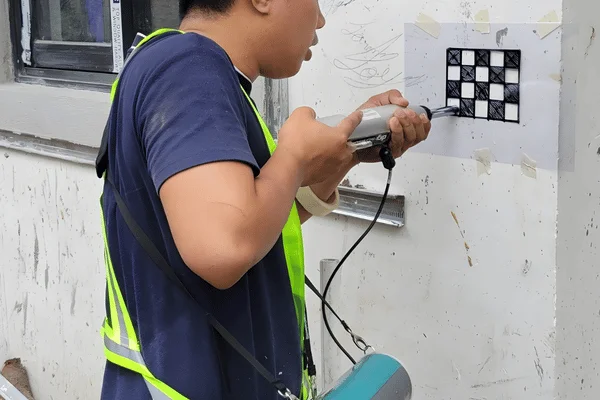
The Rebound Hammer Test works by striking a concrete surface with a controlled impact. The hammer measures the rebound distance of the impact body, which correlates with surface hardness. Higher rebound values generally indicate harder and stronger concrete, while lower values suggest weaker or deteriorated material.
ASTM C805 defines the standard procedure for Rebound Hammer Test, ensuring consistent application and interpretation across construction projects. This standard guides how testing points are selected, how readings are collected, and how results are analyzed.
Rebound Hammer Test serves as a rapid screening tool rather than a standalone replacement for full structural testing. Engineers often pair it with other evaluation methods for more reliable interpretation of concrete quality.
How Rebound Hammer Test Works
Rebound Hammer Test operates through a simple mechanical principle involving a spring-loaded mass inside the hammer device. When the plunger strikes the concrete surface, part of the energy reflects back, causing the mass to rebound. The distance of this rebound becomes the recorded value.
The surface condition plays a major role in Rebound Hammer Test results. Smooth, dry, and properly prepared surfaces produce more reliable readings. Rough surfaces, moisture presence, or carbonation layers may influence results and require careful interpretation.
Field execution of Rebound Hammer Test begins with selecting test locations that represent the structure. Engineers avoid edges, cracks, and visibly damaged areas unless those conditions are part of the assessment objective. Multiple readings are taken across each test area to improve reliability.
After collecting readings, the average rebound value is computed. This value is then correlated with estimated compressive strength using established charts or calibration curves. The output of Rebound Hammer Test provides an indication of concrete strength variation across different structural members.
Applications of Rebound Hammer Test in Construction
Rebound Hammer Test plays a key role in construction quality evaluation and structural assessment due to its flexibility and speed of execution.
One primary application of Rebound Hammer Test involves concrete quality verification during construction. Engineers use the method to check whether freshly cast concrete meets expected strength ranges before proceeding with additional loads or structural work.
Rebound Hammer Test also supports uniformity assessment. Concrete placement can sometimes result in uneven mixing, curing, or compaction. By performing multiple tests across a slab, beam, or column, weak zones can be identified early.
Structural condition monitoring represents another important use of Rebound Hammer Test. Existing buildings and infrastructure often require evaluation due to aging, environmental exposure, or changes in usage. The method helps determine whether concrete quality remains acceptable or shows signs of deterioration.
Rebound Hammer Test also supports rehabilitation planning. When infrastructure shows visible signs of wear, engineers use test results to guide repair strategies and prioritize strengthening areas.
Advantages of Rebound Hammer Test
Rebound Hammer Test offers several practical benefits for construction and structural evaluation projects.
One major advantage of Rebound Hammer Test is its non-destructive nature. The test does not damage concrete surfaces, allowing repeated evaluation over time without affecting structural integrity.
Speed represents another benefit of Rebound Hammer Test. Results are available immediately after testing, making it suitable for field conditions where quick decisions are required.
Rebound Hammer Test also provides cost efficiency compared to destructive methods such as core sampling. The equipment is portable, and testing can be performed without extensive setup or laboratory preparation.
Another advantage lies in coverage. Rebound Hammer Test allows evaluation of large surface areas within a short time, making it useful for structural surveys of buildings, bridges, and pavements.
Limitations of Rebound Hammer Test
Rebound Hammer Test also has limitations that must be considered during interpretation.
Surface condition significantly affects Rebound Hammer Test results. Factors such as moisture content, surface roughness, and carbonation can influence rebound readings and reduce accuracy if not properly accounted for.
Rebound Hammer Test evaluates surface hardness rather than full-depth concrete strength. This means results may not fully represent internal conditions, especially for thick structural members.
Calibration and correlation remain necessary for reliable interpretation. Rebound Hammer Test results often require comparison with core samples or other non-destructive methods for higher accuracy.
Because of these limitations, engineers use Rebound Hammer Test as part of a broader testing strategy rather than a sole basis for structural acceptance.
Rebound Hammer Test vs Other Concrete Testing Methods
Rebound Hammer Test differs from other concrete evaluation methods in both purpose and accuracy.
Core testing involves extracting concrete samples for laboratory compressive strength testing. While this method provides high accuracy, it damages the structure and requires patching after sampling. Rebound Hammer Test avoids this issue by keeping the structure intact.
Ultrasonic Pulse Velocity testing measures wave transmission through concrete. This method evaluates internal quality and detects cracks or voids. Rebound Hammer Test focuses on surface hardness, making both methods complementary when used together.
Combining Rebound Hammer Test with other evaluation techniques improves overall reliability. Engineers often integrate multiple results to form a more complete assessment of structural condition.
Role of Rebound Hammer Test in DPWH and ASTM Compliance
Rebound Hammer Test follows ASTM C805 standards, which define procedures for consistent testing and reporting. Standardization ensures that results remain comparable across different projects and laboratories.
DPWH-BRS accredited laboratories apply Rebound Hammer Test as part of quality assurance for infrastructure projects. This includes roads, bridges, buildings, and government facilities.
Rebound Hammer Test supports compliance verification during construction stages and post-construction evaluation. It helps confirm whether concrete meets required specifications before project turnover or rehabilitation decisions.
Accredited laboratories such as Inch-On Materials Testing Laboratory maintain calibrated equipment and trained personnel to ensure accurate Rebound Hammer Test execution aligned with national and international standards.
Why Choose Inch-On Materials Testing Laboratory
Inch-On Materials Testing Laboratory provides professional Rebound Hammer Test services across construction sites in the Philippines. As a DPWH-BRS accredited laboratory established in 2018, the team delivers reliable field and laboratory testing for soil, concrete, and foundation systems.
Rebound Hammer Test services are performed using calibrated equipment and standardized procedures based on ASTM C805. Each test follows strict field protocols to ensure accurate readings and consistent interpretation.
The laboratory also performs complementary services such as rebar scanning, soil testing, and pile testing. This integrated approach allows better evaluation of structural performance and construction quality.
Rebound Hammer Test results from Inch-On Materials Testing Laboratory support engineers, contractors, and project owners during quality control, inspection, and rehabilitation planning.
Related Services
Rebar Scanning (GPR and Electromagnetic Testing) provides subsurface mapping of reinforcement. This service helps identify rebar location, spacing, depth, and safe drilling zones before structural modification.
Field Testing services include on-site evaluation of soil, concrete, and foundation systems. These tests support construction quality control and compliance verification.
Laboratory Testing services involve controlled evaluation of construction materials using standardized procedures. These tests confirm whether materials meet required strength and durability specifications.
Takeaway
Rebound Hammer Test remains one of the most practical non-destructive methods for evaluating concrete quality in construction and infrastructure projects. Its speed, portability, and cost efficiency make it suitable for both new construction and existing structure assessment.
Rebound Hammer Test supports engineers in identifying variations in concrete strength, monitoring structural condition, and planning maintenance or rehabilitation work. While not a replacement for full laboratory testing, it provides valuable insight when used alongside other evaluation methods.
Reliable interpretation of Rebound Hammer Test results depends on proper execution, calibration, and adherence to ASTM C805 standards. Accredited laboratories such as Inch-On Materials Testing Laboratory ensure accurate application of this method for safe and informed engineering decisions.
Frequently Asked Questions (FAQ)
What is Rebound Hammer Test used for?
Rebound Hammer Test estimates concrete strength by measuring surface hardness. It is commonly used for quality control, structural assessment, and condition monitoring.
Is Rebound Hammer Test accurate?
Rebound Hammer Test provides an estimate rather than exact compressive strength. Accuracy improves when combined with other methods such as core testing or ultrasonic testing.
Does Rebound Hammer Test damage concrete?
Rebound Hammer Test is non-destructive and does not cause structural damage when properly performed.
Can Rebound Hammer Test be used on old structures?
Rebound Hammer Test is commonly used on existing buildings and infrastructure to evaluate deterioration and support rehabilitation planning.
What standards apply to Rebound Hammer Test?
Rebound Hammer Test follows ASTM C805, which defines procedures for testing and interpretation.
Why is Rebound Hammer Test important in construction?
Rebound Hammer Test provides quick insight into concrete quality, helping engineers make informed decisions during construction and maintenance activities.