Construction projects rely heavily on the strength and stability of the soil beneath them. The Standard Penetration Test is a critical tool used to assess soil density, consistency, and bearing capacity, providing essential data that guides engineers in designing safe foundations. This test has become a standard requirement for residential, commercial, and infrastructure projects across the Philippines. Contractors and developers benefit from accurate information on soil properties before construction begins, minimizing risks and ensuring long-term structural stability. Inch-On Materials Testing Laboratory specializes in conducting the Standard Penetration Test and comprehensive geotechnical soil investigations, helping construction teams achieve reliable results.
Understanding the soil profile allows engineers to make informed decisions about foundation design, excavation, and construction methods. Without proper soil testing, projects can face costly delays, structural issues, or even safety hazards. The Standard Penetration Test offers a practical and proven method for evaluating subsurface conditions, making it an indispensable part of every geotechnical investigation.
What is the Standard Penetration Test (SPT)?
The Standard Penetration Test is a widely used in-situ test designed to measure the resistance of soil to penetration, providing a reliable indicator of soil density and consistency. During the test, a split spoon sampler is driven into the soil using a standardized hammer, and the number of blows required to penetrate a specific depth is recorded. This value, known as the N-value, reflects the soil’s resistance to penetration and allows engineers to classify soil types, evaluate compaction, and estimate bearing capacity.
SPT is applicable to a variety of soil types, including sand, silt, clay, and gravel. The results help identify weak layers that may require soil improvement or specialized foundation techniques. Soil investigation using the Standard Penetration Test ensures that foundation designs are based on accurate, site-specific data rather than assumptions.
Why SPT Matters in Construction
The Standard Penetration Test plays a pivotal role in ensuring safe construction. Soil conditions directly influence foundation design, structural integrity, and long-term performance of buildings and infrastructure. Weak or loose soils can lead to settlement, tilting, or structural failure if not properly assessed. The SPT provides engineers with quantifiable data to determine the soil’s load-bearing capacity, enabling them to select appropriate foundation types such as shallow footings, mat foundations, or deep piles.
In urban areas of the Philippines, where soil conditions can vary significantly within short distances, the Standard Penetration Test is crucial for identifying potential risks. It allows project teams to plan excavation, compaction, and reinforcement strategies with confidence. Incorporating SPT results into engineering designs reduces uncertainty, prevents unexpected construction challenges, and helps maintain compliance with local building codes and DPWH standards.
SPT Procedure and Equipment
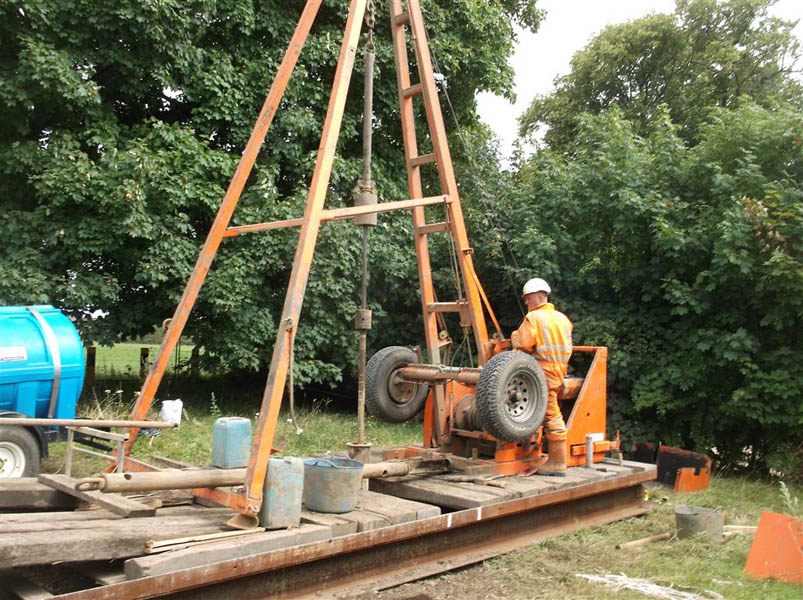
Conducting the Standard Penetration Test involves several standardized steps to ensure accurate and repeatable results. A drill rig is used to bore a test hole at the project site, and a split spoon sampler is lowered to the bottom of the borehole. A hammer of known weight and drop height drives the sampler into the soil. The number of blows required to achieve penetration for each segment, typically 15 cm intervals, is recorded. The sum of blows for the last two segments provides the N-value used for soil evaluation.
SPT equipment used by Inch-On Materials Testing Laboratory includes modern drill rigs, calibrated hammers, split spoon samplers, and recording devices to ensure precise measurements. Field technicians follow strict protocols to maintain consistency and accuracy during testing. Samples collected during the Standard Penetration Test are often retained for laboratory analysis, including moisture content determination, grain size distribution, and Atterberg limits testing. Combining field measurements with laboratory testing provides a comprehensive understanding of soil conditions.
Interpreting SPT Results
Interpreting Standard Penetration Test results requires understanding the relationship between N-values and soil characteristics. Low N-values indicate loose or soft soil, while higher N-values suggest dense or stiff soil. These values help engineers classify soil layers, evaluate compaction, and estimate the bearing capacity for various foundation types.
SPT results also assist in predicting settlement behavior. For instance, clay layers with low N-values may undergo consolidation over time, requiring deeper foundations or soil stabilization techniques. In sandy soils, N-values help determine whether densification or compaction is necessary before construction. By integrating SPT data into geotechnical reports, engineers can make informed recommendations that ensure safety, efficiency, and cost-effective foundation design.
Inch-On’s Approach to Geotechnical Soil Investigation
Inch-On Materials Testing Laboratory provides comprehensive geotechnical soil investigations, combining field and laboratory testing to deliver reliable results. As a DPWH-BRS accredited laboratory, Inch-On conducts the Standard Penetration Test according to ASTM and AASHTO standards, ensuring compliance with national and international guidelines.
Field testing services include the Standard Penetration Test, cone penetration tests, and pile load assessments. Laboratory testing complements these results with soil classification, compaction analysis, moisture content measurement, and Atterberg limits testing. This dual approach allows Inch-On to provide a detailed assessment of subsurface conditions, helping engineers design safe foundations tailored to the site’s specific soil profile.
Choosing a trusted laboratory like Inch-On ensures that construction projects receive accurate, actionable information. Engineers and contractors benefit from timely reports, precise data, and expert guidance on interpreting results, reducing the likelihood of costly errors and project delays.
Common Applications of the Standard Penetration Test in Philippine Construction
The Standard Penetration Test is widely applied across residential, commercial, and infrastructure projects throughout the Philippines. It is particularly useful for:
- High-rise buildings requiring deep foundation support
- Roads, bridges, and highway projects managed by DPWH
- Industrial facilities with heavy loads and equipment
- Coastal or reclaimed land construction where soil conditions are variable
SPT helps identify areas of loose or weak soil that may need reinforcement, densification, or deep foundations. Using the Standard Penetration Test as part of a geotechnical investigation ensures that projects meet safety standards, reduce risk of structural issues, and comply with regulatory requirements.
Advantages of Using SPT for Soil Investigation
Standard Penetration Test offers several advantages for construction projects:
- Provides direct, on-site measurement of soil resistance
- Supplies N-values for engineering design and foundation selection
- Helps detect weak layers and potential settlement risks
- Offers reliable data for both shallow and deep foundation planning
- Facilitates compliance with DPWH standards and construction regulations
Its simplicity, cost-effectiveness, and reliability make the Standard Penetration Test a preferred choice for engineers and contractors in the Philippines. The test results can also be combined with laboratory soil analyses to produce a comprehensive geotechnical report.
Ensuring Accurate Results with Inch-On
Accuracy in conducting the Standard Penetration Test is essential for actionable results. Inch-On Materials Testing Laboratory employs trained technicians and calibrated equipment to minimize variability and errors. Site-specific factors such as water table levels, soil layering, and environmental conditions are carefully considered during testing.
Samples collected during the Standard Penetration Test are analyzed further in the laboratory for moisture content, compaction, grain size distribution, and other soil properties. This integrated approach ensures that engineers receive precise data that supports reliable design decisions.
Takeaway
The Standard Penetration Test remains a cornerstone of geotechnical investigation, providing critical insights into soil density, consistency, and load-bearing capacity. Accurate SPT results allow engineers to design foundations that are safe, cost-effective, and suited to the specific site conditions in the Philippines. Inch-On Materials Testing Laboratory offers professional, accredited testing services that combine field measurements and laboratory analysis, supporting construction projects with reliable data and expert guidance.
Contractors, developers, and engineers can depend on Inch-On to deliver thorough and accurate Standard Penetration Test services, ensuring that every foundation is built on solid ground.
FAQ
What is the Standard Penetration Test?
The Standard Penetration Test is an in-situ soil test that measures soil resistance to penetration, producing N-values that indicate soil density and consistency.
How deep does SPT testing go?
Depths vary depending on project requirements, but SPT can be conducted from a few meters to tens of meters to evaluate soil conditions for shallow or deep foundations.
Why is SPT important for construction?
SPT provides essential data for foundation design, detects weak soil layers, predicts settlement behavior, and helps engineers ensure structural safety.
Can SPT be used for all soil types?
Yes, the Standard Penetration Test is suitable for sands, silts, clays, and gravels, though interpretation varies depending on soil characteristics.
Who conducts SPT in the Philippines?
Accredited laboratories like Inch-On Materials Testing Laboratory perform SPT with trained technicians and certified equipment, ensuring compliance with DPWH and international standards.
How are SPT results used in foundation design?
Engineers use N-values from the Standard Penetration Test to determine soil bearing capacity, select appropriate foundation types, and plan compaction or soil improvement measures if necessary.