Grout plays an important role across many construction applications, supporting connections, filling voids, securing components, and helping transfer loads between structural elements. Because grout can become part of a critical construction assembly, its quality should be verified through suitable inspection and testing procedures. Grout integrity testing Philippines provides engineers, contractors, developers, and project owners with technical information that can support construction quality control and material verification.
A reliable testing program can help identify concerns related to grout strength, consistency, placement, or internal condition. Testing requirements vary according to grout type, application, project specifications, and applicable standards, so selecting the correct evaluation procedure is essential.
For construction teams seeking professional materials testing support, Inch-On Materials Testing Laboratory provides independent laboratory and field testing services for soil and construction materials. The laboratory was established in November 2018 and is accredited by the Department of Public Works and Highways – Bureau of Research and Standards (DPWH-BRS). Inch-On also follows ASTM and AASHTO testing standards for its applicable services.
What Is Grout Integrity Testing?
Grout integrity testing Philippines refers to the evaluation of grout quality or installed grout condition using suitable testing and inspection procedures. The purpose is to obtain measurable technical information that can help determine whether grout meets specified project requirements.
Depending on the application, an evaluation may focus on properties such as compressive strength, density, consistency, uniformity, or the presence of internal defects. For existing installations, specialized non-destructive or investigative techniques may also be considered when appropriate.
There is no single test that applies to every type of grout or every construction project. Engineers and testing professionals should first identify the grout material, intended application, project specifications, required acceptance criteria, and applicable testing standards.
A properly planned Grout integrity testing Philippines program can therefore provide useful information for construction quality control while helping project teams make decisions based on documented test results rather than visual inspection alone.
Why Grout Integrity Testing Matters for Philippine Construction Projects
Construction projects require many materials to work together as part of a larger structural system. Grout may occupy a relatively small area compared with concrete, steel, or masonry, yet its condition can still matter for the performance of the component where it is installed.
Grout integrity testing Philippines can support several important project objectives.
Helps Verify Material Quality
Testing provides measurable information about selected properties of a grout material. Results can be compared against project specifications or applicable acceptance criteria.
This approach gives engineers and quality-control personnel documented information that can supplement site observations, delivery records, installation procedures, and other construction documents.
Supports Construction Quality Control
Quality control involves more than checking finished surfaces. Material sampling, specimen preparation, laboratory analysis, field evaluation, and technical reporting can all contribute to a structured construction quality-control program.
A suitable Grout integrity testing Philippines program can help project teams monitor material performance throughout relevant stages of construction.
Helps Identify Potential Problems Early
Questions about grout quality are easier to investigate when samples, records, and test results are available. Early identification of unusual results may allow project teams to review mixing, placement, curing, material handling, or other relevant factors.
Testing does not replace engineering judgment. Instead, it provides technical information that engineers can consider alongside drawings, specifications, construction records, and site observations.
Supports Technical Documentation
A professional laboratory report can provide a documented record of the testing performed, samples evaluated, methods used, measurements obtained, and reported results.
Such documentation can be valuable for contractors, developers, engineers, inspectors, and project owners who need traceable quality-control records.
Helps Verify Project Requirements
Construction projects can have specific material requirements based on design documents, specifications, applicable codes, and recognized testing standards. Grout integrity testing Philippines can help determine whether the selected testing program addresses those requirements.
Common Applications Where Grout Quality May Need Verification
Grout is used across different construction activities, so testing requirements can vary considerably. The selected evaluation method should match the actual application.
Foundation and Structural Applications
Certain foundation and structural systems use grout as part of connections, filling operations, equipment support, or other construction details. Where grout contributes to load transfer or structural performance, verification may form part of a broader quality-control program.
Equipment Base Grouting
Industrial equipment may require a stable support interface between machinery bases and supporting surfaces. Grout quality can become an important consideration when the material is specified as part of an equipment-support system.
Reinforced Concrete Applications
Some construction details may use grout alongside reinforced concrete components. Appropriate testing can provide additional information regarding specified material properties.
Masonry and Construction Joints
Grout may also be associated with masonry construction and selected joint or connection applications. The required evaluation depends on the design, material specification, construction method, and applicable standard.
Infrastructure Projects
Roads, bridges, industrial facilities, commercial buildings, public structures, and other infrastructure projects may have material testing requirements that include grout or related construction materials.
A professional Grout integrity testing Philippines program should always account for the specific project rather than applying a generic test package to every application.
Grout Integrity Testing Methods and Evaluation Procedures
The appropriate Grout integrity testing Philippines method depends on what engineers need to verify. Some projects require laboratory testing of representative specimens, while others may require field evaluation of an installed system.
Compressive Strength Testing
Compressive strength is a key property for many cementitious construction materials. Where grout specifications require compressive strength verification, properly prepared specimens may be cured under controlled conditions and tested using an appropriate standardized procedure.
Results can then be compared with the strength requirement established by the project specification or applicable standard.
The actual specimen dimensions, curing conditions, testing age, loading procedure, and acceptance criteria should follow the applicable test method and project requirements.
Sampling and Specimen Preparation
Accurate testing starts with appropriate sampling.
Samples should be properly identified and associated with relevant project information. Depending on the testing requirement, specimens may need controlled preparation and curing before laboratory evaluation.
Important documentation can include:
- Project name
- Sampling location
- Date and time
- Material identification
- Batch information
- Sample identification
- Requested test
- Applicable specification
- Relevant site information
Proper sample traceability helps connect laboratory results with the material and construction activity represented by each sample.
Density and Consistency Evaluation
Certain grout applications may require evaluation of physical properties such as density or consistency. These measurements can provide useful information about material uniformity and preparation when required by the applicable specification.
The exact procedure should be selected according to the grout type and testing objective.
Non-Destructive or In-Situ Evaluation
Existing construction may require investigation without removing large sections of finished material. Depending on the structure and evaluation objective, specialized non-destructive techniques may provide useful information.
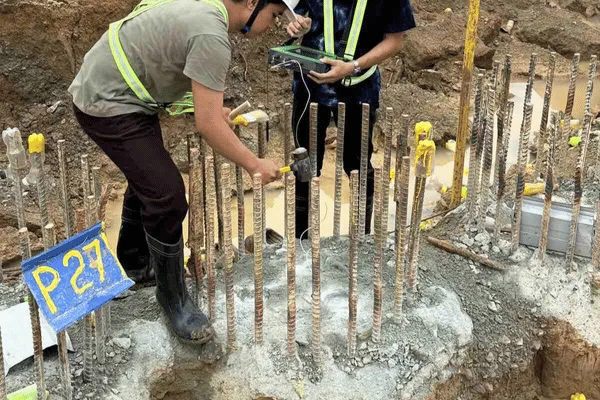
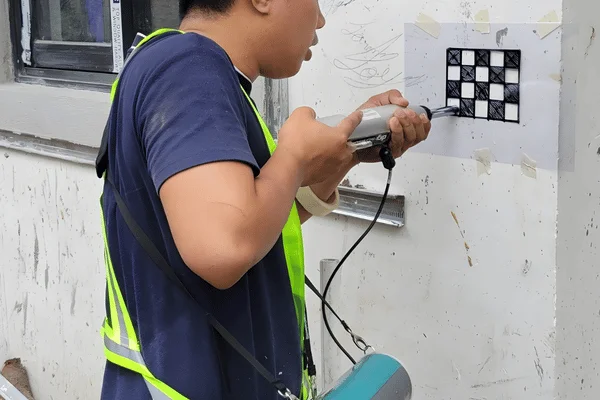
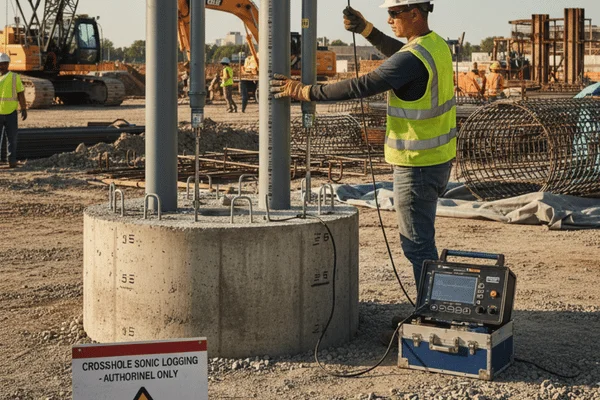
Inch-On provides several field-testing services for concrete and foundation-related applications, including Ultrasonic Testing, Rebound Hammer Testing, Rebar Scanning, Pile Integrity Testing, and Crosshole Sonic Logging.
Such methods should not automatically be treated as direct substitutes for every grout test. Their suitability depends on the actual material, structure, access conditions, testing objective, and applicable procedure.
Laboratory Testing
Laboratory testing provides controlled conditions for evaluating construction materials. Inch-On describes its laboratory service as quality testing of soil and construction materials using specialized apparatus and standardized testing procedures. Its listed laboratory services include aggregate testing, asphalt testing, soil testing, reinforced steel testing, and Concrete Hollow Block testing.
For a Grout integrity testing Philippines requirement, the laboratory should first review the project specifications and testing objective so the appropriate procedure can be identified.
ASTM and AASHTO Standards for Construction Material Testing
Recognized testing standards help establish consistent procedures for sample preparation, equipment use, measurement, and reporting. ASTM and AASHTO standards are widely used across construction and engineering material testing.
Inch-On states that its applicable testing services follow ASTM and AASHTO standards and that the laboratory is accredited by DPWH-BRS.
Why Standardized Procedures Matter
A standardized procedure provides a defined framework for conducting a test. This can improve consistency between samples and provide engineers with results that are easier to interpret against established requirements.
Standardized procedures may address areas such as:
- Sample preparation
- Equipment requirements
- Testing conditions
- Measurement techniques
- Calculation procedures
- Reporting requirements
Choosing the Correct Standard
Not every ASTM or AASHTO procedure applies to every grout material. The correct standard should be selected according to the material, intended use, testing objective, and project specification.
This is particularly important when planning Grout integrity testing Philippines, because a test selected without considering the actual grout application may fail to answer the engineering question that prompted the testing.
How Grout Testing Supports Construction Quality Control
A well-organized testing process can help construction teams maintain traceability from material sampling through final reporting.
Step 1 — Define the Testing Requirement
Identify the grout type, intended application, required property, project specification, acceptance criteria, and applicable testing standard.
Step 2 — Collect Representative Samples
Samples should represent the material being evaluated and should be properly identified for traceability.
Step 3 — Prepare and Cure Test Specimens
Where specimen-based testing is required, samples should be prepared and cured according to the applicable procedure.
Step 4 — Conduct Laboratory or Field Testing
The selected test is performed using suitable equipment and procedures. Depending on the project, this may involve laboratory evaluation, field inspection, or a combination of methods.
Step 5 — Analyze Results
Measured results are reviewed against the applicable specification or acceptance criteria.
Step 6 — Prepare the Technical Report
The report should clearly document the test performed, sample information, relevant measurements, results, and other required technical details.
Step 7 — Support Project Decisions
Engineers and project teams can use the results alongside other project information when assessing construction quality or determining appropriate next steps.
Why Choose a Professional Materials Testing Laboratory?
Professional testing can provide a structured approach to construction-material evaluation.
A qualified laboratory can offer:
- Trained technical personnel
- Specialized testing equipment
- Standardized procedures
- Controlled laboratory conditions
- Field-testing capability
- Sample traceability
- Technical reporting
- Independent material evaluation
- Support for project-specific testing requirements
Inch-On Materials Testing Laboratory provides both laboratory and field testing services. Its field-testing scope includes soil, concrete, and foundation pile evaluation, while its laboratory services cover soil and various construction materials.
Why Inch-On Materials Testing Laboratory for Construction Material Testing?
Selecting a testing laboratory requires attention to accreditation, testing capability, technical procedures, equipment, and reporting.
DPWH-BRS Accredited Engineering and Construction Laboratory
Inch-On Materials Testing Laboratory was established in November 2018 and is accredited by the Department of Public Works and Highways – Bureau of Research and Standards. The laboratory operates as an independent testing facility focused on soil and construction-material quality verification.
Experience with Laboratory and Field Testing
Inch-On combines laboratory testing with field-based evaluation. Its stated field-testing services include soil, concrete, and foundation pile testing, while its laboratory services cover several categories of construction materials.
This broader testing capability can be useful for projects where grout quality must be considered alongside concrete, soil, reinforcement, or foundation conditions.
ASTM and AASHTO Testing Standards
Inch-On states that its testing services follow applicable ASTM and AASHTO standards. Standardized testing procedures provide a structured basis for material evaluation and technical reporting.
Specialized Testing Equipment
Materials testing depends on appropriate equipment, controlled procedures, and trained personnel. Inch-On highlights specialized equipment for its laboratory and field testing services, supporting evaluation of construction materials and structural components.
Structural and Foundation Testing Capabilities
Beyond conventional laboratory material testing, Inch-On provides several field evaluation services. These include Pile Integrity Testing, Pile Dynamic Testing, Crosshole Sonic Logging, Ultrasonic Testing, Rebound Hammer Testing, and Rebar Scanning.
These services can be relevant when a project requires broader structural or foundation evaluation alongside construction-material testing.
What Can Affect Grout Integrity?
Several construction factors may affect grout performance. A testing program can help provide measurable information, but test results should always be reviewed alongside project records and engineering requirements.
Potential factors include:
- Incorrect water-to-material ratio
- Poor mixing
- Improper placement
- Segregation
- Voids
- Contamination
- Improper curing
- Incorrect material storage
- Poor sampling practices
- Unsuitable environmental conditions
- Failure to follow specified procedures
Material quality is only one part of the overall construction process. Mixing, transportation, placement, curing, inspection, and documentation can also affect the final condition of a grout installation.
When unusual test results occur, engineers may need to review material records, site conditions, installation procedures, and other relevant information before determining an appropriate response.
When Should Grout Integrity Testing Be Performed?
The timing of testing depends on the project requirements and testing objective.
Before Construction
Testing may be required to establish material properties or confirm suitability before a material is incorporated into construction.
During Construction
Sampling and testing can support ongoing quality-control activities. Regular testing may help project teams monitor consistency between batches when such monitoring is specified.
After Grout Placement
Testing or investigation may be required when engineers need to verify specified properties or examine concerns associated with installed grout.
During Structural Investigation
Existing structures may require specialized evaluation when questions arise about material condition, internal defects, or structural performance.
The appropriate Grout integrity testing Philippines approach should therefore be established before testing begins, with clear agreement regarding the test objective, applicable standard, sampling procedure, and reporting requirements.
How to Select a Grout Testing Laboratory in the Philippines
Choosing a laboratory requires more than comparing service prices. Project teams should examine whether the laboratory has the appropriate accreditation, equipment, technical capabilities, and reporting process for the required work.
Consider these factors:
Relevant Accreditation
Check whether the laboratory holds appropriate accreditation for its stated testing scope.
Applicable Testing Standards
Ask which ASTM, AASHTO, project, or other recognized procedures apply to the requested evaluation.
Laboratory Experience
Consider experience with construction-material testing and projects that require formal technical documentation.
Field-Testing Capability
For existing structures or site-based investigations, determine whether the laboratory can provide suitable field services.
Equipment and Calibration
Testing equipment should be suitable for the required procedure and maintained according to appropriate quality-control practices.
Technical Personnel
Qualified personnel should understand sample handling, testing procedures, measurements, calculations, and reporting.
Reporting Process
A useful laboratory report should clearly identify the sample, test procedure, results, and other relevant project information.
Project Requirements
Provide the laboratory with drawings, specifications, material information, sampling details, and acceptance criteria whenever available.
For Grout integrity testing Philippines, these details help the laboratory understand exactly what the project needs before a test procedure is selected.
Questions to Ask Before Grout Integrity Testing
Project teams can ask several questions before arranging testing:
- What type of grout is being evaluated?
- Where is the grout being used?
- What property needs verification?
- What standard does the project specification require?
- How should samples be collected?
- How many samples are required?
- Are laboratory tests, field tests, or both required?
- What acceptance criteria should be applied?
- What project documents should accompany each sample?
- What information should appear on the final report?
Providing clear answers to these questions can help reduce confusion and ensure the testing program addresses the actual project requirement.
Frequently Asked Questions About Grout Integrity Testing Philippines
What is grout integrity testing?
Grout integrity testing Philippines involves evaluating grout quality, specified properties, or installed condition through appropriate laboratory or field procedures. The exact test depends on the grout type, construction application, project requirements, and applicable standard.
Why is grout integrity testing important?
Testing provides measurable technical information that can support construction quality control. It can help project teams compare material properties against specified requirements and investigate potential concerns.
What tests can be performed on grout?
Possible evaluations may include compressive strength and selected physical-property tests, depending on the grout type and project requirements. Existing installations may also require specialized investigative or non-destructive methods.
Does grout integrity testing apply to existing structures?
Potentially, yes. Existing structures may require specialized field evaluation when engineers need information about installed material condition. The appropriate method depends on accessibility, material type, structural configuration, and testing objective.
Are ASTM standards used for grout testing?
ASTM standards are widely used for construction-material testing, but the correct procedure depends on the material and testing purpose. Inch-On states that its applicable testing services follow ASTM and AASHTO standards.
Can a materials testing laboratory perform field testing?
Yes. Inch-On provides field-testing services for soil, concrete, and foundation piles, alongside laboratory testing of construction materials.
Why should grout samples be properly identified?
Proper identification helps maintain sample traceability. Information such as project name, sampling location, date, material identification, and sample number can help connect laboratory results with the relevant construction activity.
How can I arrange grout testing in the Philippines?
Start by providing the testing laboratory with details about the grout, its application, project specifications, required property, sampling requirements, and desired testing timeframe. Inch-On Materials Testing Laboratory can review the project information and identify the applicable testing requirements based on the available scope and standards.
Takeaway
Grout integrity testing Philippines can provide valuable technical information for construction quality control, material verification, and structural evaluation. Since grout applications vary considerably, testing should be selected according to the material, intended use, project specifications, acceptance criteria, and applicable standards.
Professional testing can provide documented results that complement site inspection, construction records, engineering analysis, and quality-control procedures. Laboratory testing can evaluate prepared specimens under controlled conditions, while suitable field-testing methods can support investigation of existing structural components.
Inch-On Materials Testing Laboratory is a DPWH-BRS accredited Engineering and Construction Laboratory established in November 2018. Its services cover laboratory and field testing of soil, concrete, foundation piles, and other construction materials. The laboratory states that applicable services follow ASTM and AASHTO standards and uses specialized testing equipment for material and structural evaluation.
For contractors, developers, engineers, and project owners looking for Grout integrity testing Philippines, the first step is to define the testing objective and provide the laboratory with the relevant project requirements. A properly selected testing program can provide clear technical data to support informed construction quality-control decisions.
Contact Inch-On Materials Testing Laboratory to discuss your grout, construction-material, laboratory, or field-testing requirements and determine which evaluation procedure is appropriate for your project.